Why HIPAA Applies Directly to Medical Billing Companies
A medical billing company is virtually always a business associate under HIPAA. Meaning it creates, receives, maintains or transmits PHI on behalf of a covered entity, which is the practice, clinic or hospital it invoices for. In the more restrictive example, a billing business is a covered entity only when it is acting as a healthcare clearinghouse, translating nonstandard data into standard transactions.
PHI is found in more locations than you may think in a regular billing workflow:
- Billing team logs into the practice management system and EHR Payer portals for eligibility, prior authorisations and claim status.
- The 837 and 835 files travelling through clearinghouse accounts
- ERAs, paper EOBs, and lockbox or deposit records used for posting payments
- Denial forms, appeal letters, and medical records submitted to payers
- Patient declarations, vendor statements and recorded collection calls
- Spreadsheets, AR reports and email chains between the biller and the practice
- A real compliance programme must include all of these, not just the EHR.
What's Changed in 2026 (and What Hasn't)
- The existing Security Rule remains in effect. Today's standards judge any transgression.
- The proposal indicates where things are going. It would require multi-factor authentication and encryption, not “addressable”. It would also demand a formal inventory of assets and network map, and compel covered organisations to verify that their business associates genuinely have measures in place. This isn't set in stone yet, but it is a solid concept.
- Penalties increased. HHS made its annual inflation adjustment on January 28, 2026. Civil penalties now begin at $145 per violation, with the regulation's annual ceiling per violation set at $2,190,294 (HIPAA Journal).
- Revised behavioural health alerts. On February 16, 2026, providers that maintain substance use disorder records regulated by 42 CFR Part 2 were required to update their Notice of Privacy Practices. OCR is currently enforcing Part 2 (HHS model notices) If you bill psychiatry, therapy, or SUD programmes, your workflows should respect the more restrictive disclosure regulations that govern those records.
- Enforcement is based on risk analysis. OCR’s Risk Analysis Initiative has resulted in more than a dozen settlements. In April 2026 alone, four ransomware attacks referenced the same gap, and it took them out. The OCR has also suggested that the next enquiry is whether organisations actually addressed the dangers they detected.
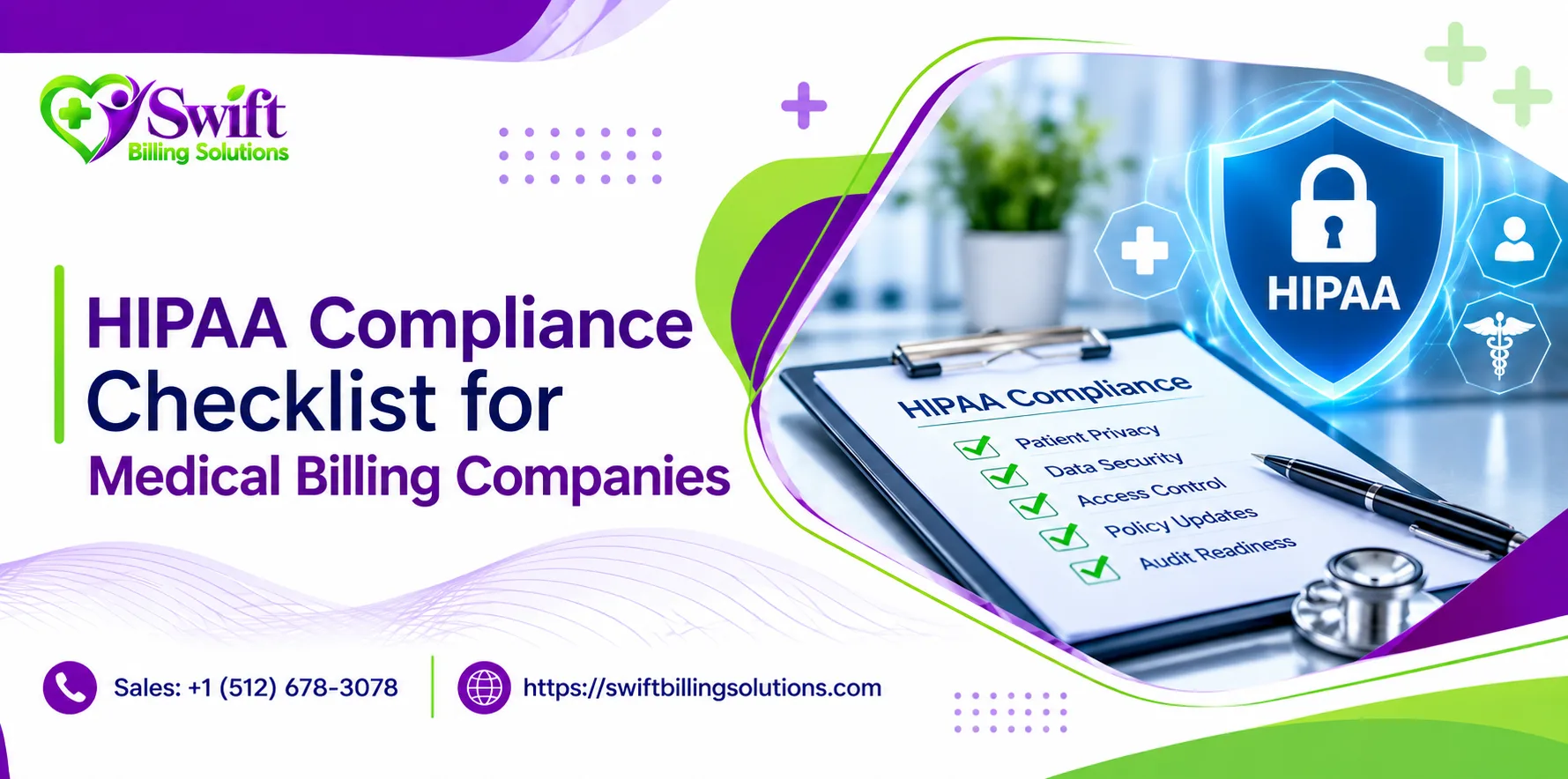
HIPAA Compliance Checklist
1. Business Associate Agreements
The BAA is the contract that puts the rest in stone. It should correspond to the services that are actually provided.
- Signed BAA with all clients before any PHI transfer
- Subcontractor BAAs with all downstream vendors that have access to PHI: clearing house, statement and print vendor, cloud storage, answering service, collecting agency, transcription
- A written definition of the breach notification timeframe (most BAAs establish something far less than HIPAA’s 60-day outer limit)
- Terms for return or destruction of PHI when contract terminates
- Annual evaluation of all ongoing BAAs against current services and vendors
2. Security and Privacy Officers
- Somebody needs to own this. In a small organisation, one individual can do both jobs.
- Designated Privacy Officer and Security Officer with written responsibilities
- A single point of contact for clients to ask enquiries or report issues related to privacy
3. Security Risk Analysis and Risk Management
- Documented risk analysis of all systems that contain ePHI, including PM/EHR access, payer portals, clearinghouse, email, file shares, laptops, phones, and backups
- A remediation plan with owners and target dates for each identified risk
- Proof that these fixes were indeed done
- At least annually and after significant changes such as a new customer EHR, new office, or new vendor
4. Policies and Procedures in Writing
- Documented risk analysis of all systems that contain ePHI, including PM/EHR access, payer portals, clearinghouse, email, file shares, laptops, phones, and backups
- A remediation plan with owners and target dates for each identified risk
- Proof that these fixes were indeed done
- At least annually and after significant changes such as a new customer EHR, new office, or new vendor
5. Controlling access
- Unique user ID for each staff member in each client system and in the payer portal
- Multi-factor authentication on PM/EHR, clearinghouse, email, and remote access
- Role-based access - only what each individual needs
- Revoke access the same day someone quits or changes positions
- Periodic audit of audit logs
6. Encryption and Secure Transmission
- Full disc encryption on laptops and workstations; encrypted servers and backups
- EDI, email with PHI, and file transfers across encrypted channels
- No PHI in personal email, consumer messaging apps, or unauthorised cloud folders
7. Workforce Development
- HIPAA training upon hire and a minimum of annually
- Training covers phishing awareness, as phishing is responsible for a high share of reported breaches
- Confidentiality agreements signed
- Training records preserved for 6 years
8. Remote & Offshore teams
- A lot of billing work is done remotely now, some overseas. HIPAA doesn’t prohibit either. It needs the same protections to apply wherever the work is done.
- A remote employment policy that includes private workplaces, screen privacy, no local printing, and secured networks or virtual desktops
- Remote and offshore staff on the same training, management of access and monitoring as on-site staff
- Team locations given to clients and shown in the BAA
9. Physical Protections
- Access to offices and workspaces is restricted
- Secure storage of paper EOBs, mail and printed records
- Certified Destruction Vendor or Cross Cut Shredding
- Clean desk rule at end of each shift
10. Incident Response and Breach Notification
- A written incident response plan with identified roles
- Documented four-factor breach risk assessment for each incident, including those that are not breaches
- Notification to the client within the BAA window and no later than 60 days after discovery
- A six-year incident log
11. Contingency Planning:
- Tested backups, with at least one copy offline or immutable
- Realistic recovery periods in the disaster recovery strategy.
- Alternate means of filing claims if primary clearinghouse is not accessible
12. Communications Regarding Patient Billing and Collections
- Verification of identity before discussing any balance on inbound calls
- Voicemails, emails and statements with minimum necessary information.
- Secure payment channels that do not reveal card or account data
- Clear handling of patient requests, including returning records requests to the clinic immediately
13. Data Retrieval and Offboarding
- Client systems and portals access cancelled on last day of contract
- Written certification to return or delete PHI
- A clean handoff of open AR and ongoing appeals so patients and claims aren’t left hanging
Questions to Ask Before You Hire a Billing Company
| Ask this | A good answer sounds like |
|---|---|
| When was your last security risk analysis? | A specific date within the past year, and a willingness to walk you through what it found and what was fixed |
| Will you sign our BAA, or provide yours? | Yes, before any data is shared, with breach notice and data return terms spelled out |
| Which subcontractors will touch our data? | A named list (clearinghouse, statement vendor, storage) with BAAs in place for each |
| Does every biller get their own login to our systems? | Yes, always, with MFA, and no shared credentials |
| Where is your team located, and how are remote staff secured? | A direct answer about locations, plus the specific controls used for remote work |
| How quickly will you tell us about a suspected breach? | Several days written into the BAA, usually far less than 60 |
| How do you train your staff? | Training at hire and every year, with records they can show you |
| What happens to our data if we part ways? | PHI returned or destroyed with certification, access cut on day one, and a clean AR handoff |
Common HIPAA Errors in Medical Billing
- Most billing compliance errors are not dramatic. They are little shortcuts that add up.
- A single payer portal login for the full crew. It's OK until you need to know who has seen a record and you can't tell.
- Names and dates of birth of patients in subject headers of emails. Subject lines are commonly unencrypted, even when the body of the message is.
- No BAA with statement provider. Practices generally recall the billing business, but forget the print-and-mail shop that receives every patient’s name, address and amount.
- A risk assessment done once, years ago. OCR has regularly rejected assessments as being obsolete or too narrowly scoped.
- Former personnel still active on client systems. In billing, personnel may have logins to a dozen client EHRs and portals, which makes it easy to miss offboarding.
- Overnight paper EOBs placed on desks. Physical precautions still count, especially in shared office space.
How Swift Billing Solutions Protects Your Practice's Data
At Swift Billing Solutions, we work within your existing EHR and practice management system without moving your data to another system. This means PHI is in fewer sites from day 1.
The Bottom Line
HIPAA compliance is not a binder on a shelf. It's a set of habits that show up in daily billing work: who logs in where, how files move, and what happens when something breaks. Use this checklist to find your gaps, close them, and keep the evidence.
If you would like a billing partner who takes this as seriously as your revenue, talk to Swift Billing Solutions. We will start with a free practice revenue audit and show you exactly where you stand.
This article is for general information and is not legal advice. Talk to a healthcare attorney or compliance professional about your organization’s specific obligations.
Frequently asked questions

Swift Billing Solutions Team
Our team shares practical guidance on medical billing, coding, denial management, and revenue cycle operations. We write for physicians and practice managers who want to understand billing challenges, reduce avoidable errors, and keep payments moving.